As a small builder I can build the niche guitars that aren’t commercially viable. When they become commercially viable — like my aluminum resonators did after 150 or so — I lose interest; it gets too much like a job. We live a simple life off-grid in Montana. My shop runs completely on solar, as does the house, which gives us a lot of freedom. That simplicity lets me constantly work on my experiments instead of worrying about marketing a product.
Each year I build a few electrics, one or two Weissenborns, and the occasional wood reso or archtop. Right now I’ve hit on a flat-top design — a little bright in standard tuning, but with really focused lows in lower tunings, so I’ll experiment more with that this year.
I’m more concerned with performance than appearance. If you’re only interested in inlay and mirror finishes, my guitars probably aren’t for you. My focus is on sound and playability — traits that can’t be done easily with machines or in mass production.
Materials
Most of my wood was salvaged in Central America from stumps and tops left by loggers, or from fire- and hurricane-damaged trees. In Belize I collected rosewood, granadillo rosewood burl, bastard rosewood, hubrillo and mahogany. There’s always the odd garage-sale or thrift-store piece of furniture made of mahogany or even rosewood that I salvage and use too.
I don’t do many custom orders, preferring to just offer my experiments for sale. If you’re interested in what I have on hand, get in touch.
A bit of history
I was born in Montana into a farming and ranching family. My dad went off to WWII as a pilot. He didn’t care for the military, but they had really cool airplanes, so he was a fighter pilot through Korea and Vietnam, where he was shot down. Fighter pilots move around a lot — so my first musical influences were Ray Charles and gospel music in Georgia in 1954, then England and Germany in the late ’50s and early ’60s, listening to English blues and The Beatles on Radio Luxembourg.
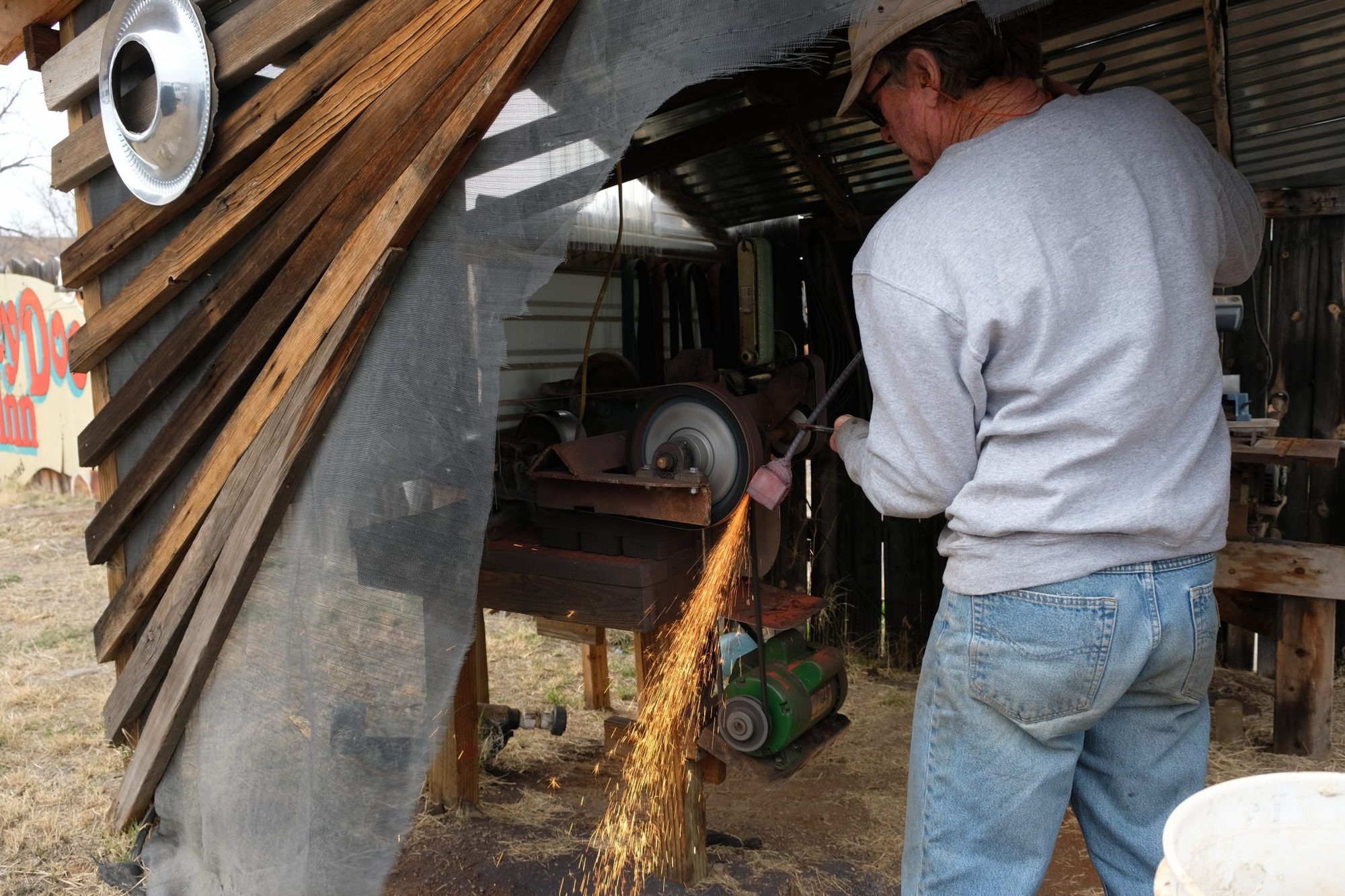
I built guitars as a hobby when I was a fine-arts student in the late ’60s, up through ’75 when disco hit and live music almost died. I began making knives, and because of a martial-arts background ended up making my own steel in the Japanese tradition — I even shared a shop with a Japanese knife and sword maker named Kuzan Oda.
In the early ’90s the collectors were ruining knife-making for people interested in functional designs, so I got back into guitar building full time.
I’ve built around 400 guitars, focusing mainly on sound and playability — traits that can’t be achieved by machines and mass production.